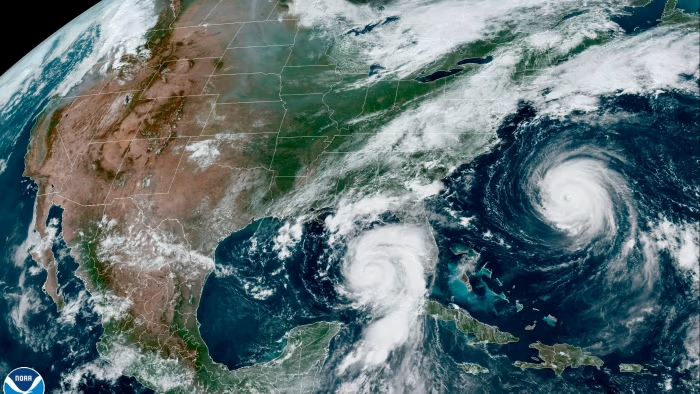
Artificial intelligence has enabled significant advancements in long-range weather and climate forecasting, as demonstrated by Google’s NeuralGCM model. This hybrid model combines machine learning with traditional atmospheric physics tools, allowing it to accurately track long-term climate trends and extreme weather events like cyclones. NeuralGCM outperformed traditional models in both speed and accuracy, achieving 70,000 simulation days in 24 hours using Google’s AI tensor processing units, compared to the 19 simulation days generated by the X-SHiELD model from the US National Oceanic and Atmospheric Administration.
The collaboration between Google and the European Centre for Medium-Range Weather Forecasts (ECMWF) led to the development of NeuralGCM, which utilizes 80 years of ECMWF observational data for machine learning. The model has shown significant improvements in prediction accuracy, identifying almost the same number of tropical cyclones as conventional trackers and double the number detected by X-SHiELD. Moreover, it exhibited a 15-50% lower error rate in temperature and humidity predictions compared to traditional models, indicating a promising future for integrating AI with physics-based methods in climate modeling.
Despite its success, there is still work to be done to enhance NeuralGCM’s capabilities, such as estimating the impact of CO₂ increases on global temperatures and simulating unprecedented climates. Experts like Peter Dueben from ECMWF and Cédric M. John from Queen Mary University of London acknowledge the model’s potential but also highlight areas for improvement. Google’s involvement in environmental initiatives, including satellite missions to track methane emissions and partnerships with NASA to monitor air quality, underscores its commitment to leveraging AI for sustainability and environmental monitoring.